On 23 May, the NewClimate Institute published an illuminating report entitled “EU Climate Partnerships – Fit for Purpose?” that assesses the European Union’s (EU) international engagement through various climate partnerships. Authors Sarah Jackson, Lukas Kahlen and Ines Paiva highlight both the achievements and challenges the EU faces in leveraging these partnerships to strengthen its global influence and climate diplomacy.
Since the start of the Von der Leyen Commission in 2019, the global landscape has undergone considerable transformations. The EU finds itself navigating a world marked by increased assertiveness from powers such as China and Russia, disruptions in supply chains, and concerns around energy and economic security, all under the looming threat of climate change. These factors have led the EU to recalibrate its geopolitical strategy, emphasising innovative approaches to climate diplomacy through a series of climate partnerships.
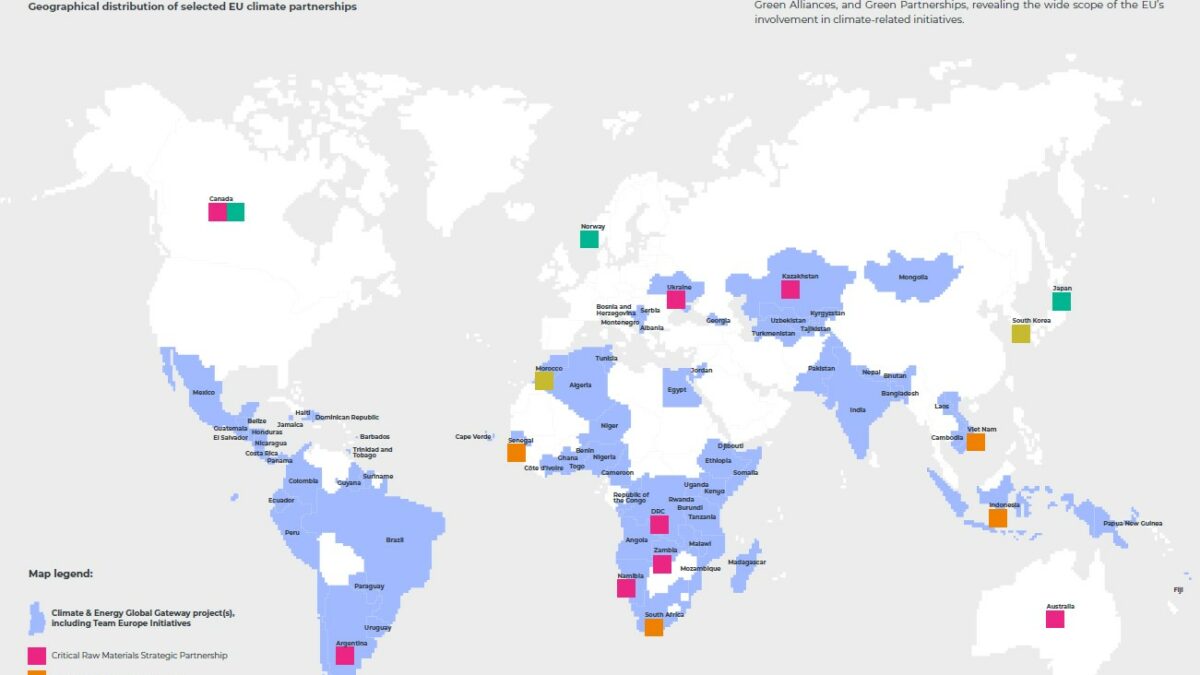
In response to China’s Belt and Road Initiative, the EU launched the Global Gateway initiative, aimed at supporting infrastructure development in emerging and developing economies, with a strong focus on green and digital transitions. Complementing this are a number of bilateral and plurilateral initiatives, including Green Alliances, Critical Commodities Strategic Partnerships and Partnerships for Just Energy Transition, which together seek to strengthen the EU’s diplomatic efforts and influence.
The report identifies significant challenges within these frameworks. The EU’s Global Gateway initiative, along with other partnership frameworks, struggles to articulate a coherent vision and achieve effective coordination both within EU institutions and with member states. Diplomatic interactions with partner countries often suffer from fragmented communication and inconsistent prioritisation, hampering the effectiveness and capacity of EU institutions.
Key recommendations to improve EU climate partnerships
To overcome these challenges, the report presents a number of strategic recommendations:
- Align EU and Member State priorities: Greater coordination between the EU and its Member States is crucial to harness the potential of the Team Europe approach, ensuring visibility, coherence and synergy in climate partnerships.
- Clearer communication: The EU needs to develop concise messages that clearly convey the objectives and benefits of its climate partnerships. Effective communication, including campaigns in local languages, can resonate more deeply with stakeholders and the general public.
- Develop a long-term strategic vision: A shared, long-term strategic vision between the EU and Member States is essential for holistic and sustainable climate partnerships, strengthening credibility and commitment.
- Clarity on responsibilities and increased resources: A clear delineation of roles and adequate resources are vital for the successful implementation of climate partnerships. EU institutions need diverse expertise and sufficient funding to meet their objectives.
- Strong political leadership: High-level political commitment is necessary to ensure the provision of resources, effective coordination and visible implementation on the ground.
Chile: A model of the EU-LAC Global Gateway Investment Agenda
A notable case highlighted in the report is the EU’s engagement with Chile under the EU-LAC Global Gateway Investment Agenda. Launched in 2023, the Team Europe Initiative for the Development of Renewable Hydrogen in Chile focuses on driving the just energy transition through renewable hydrogen production and export, aligned with Chile’s ambition to become a leader in renewable hydrogen production and export by 2040.
The initiative includes the creation of the Global Gateway Financing Platform, driven by the EU Delegation in Chile and supported by the European Investment Bank (EIB) and the German development bank KfW. It also includes the development of the RH2 Technical Assistance Project implemented by GIZ and AECID, as well as the participation of eleven Member States through different initiatives.
In the latter area, the Netherlands played a pioneering role in 2021 by establishing a maritime corridor for green hydrogen between Chile and Europe through the port of Rotterdam, in line with Chile’s National Green Hydrogen Strategy. Germany has also been instrumental, with the port of Hamburg signing agreements to facilitate hydrogen imports, underlining Germany’s leading position in hydrogen production and its strategic partnership with Chile.
This collaborative effort exemplifies how EU Member States can work together with partner countries to advance global climate goals, demonstrating the potential of well-coordinated climate partnerships.
The full report is available at the following link. For more information, visit NewClimate Institute.
Image Credit: NewClimate Institute