
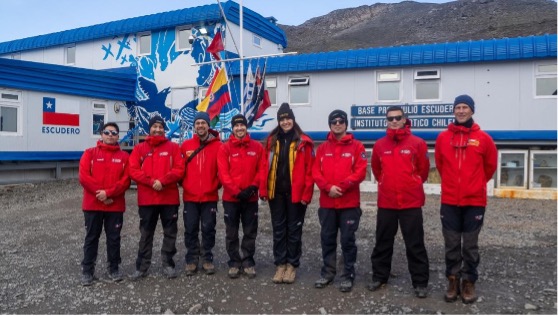
The pilot initiative is implemented at INACH’s Chilean scientific base “Profesor Julio Escudero” by the German agency GIZ and is co-financed by the European Union and Germany’s Federal Ministry for Economic Affairs and Energy. Authorities and institutions from Chile and Europe concluded a technical visit to the “Profesor Julio Escudero” scientific base of the Chilean Antarctic Institute (INACH), on King George Island, Antarctica, where progress on the Renewable Energy and Hydrogen Infrastructure pilot was presented. This initiative seeks to validate hybrid energy systems in one of the most demanding operational environments on the planet.
The activity is part of the Team Europe Renewable Hydrogen Development (RH2) project, implemented by the German agency Deutsche Gesellschaft für Internationale Zusammenarbeit (GIZ) and co-financed by the European Union (EU) and Germany’s Federal Ministry for Economic Affairs and Energy (BMWE), with the objective of strengthening international technological cooperation and generating evidence for the adoption of resilient energy solutions in isolated territories.
The pilot project is supported by the Regional Government of Magallanes and Chilean Antarctica and the Chilean Antarctic Institute (INACH), which are key institutions for its development and future outlook. This initiative, driven by the Regional Government, has been part of its strategy to position Magallanes as an international hub for energy innovation. As for INACH, the Institute plays a fundamental role as the entity in charge of the base, facilitating the technical implementation of the pilot and ensuring its alignment with the operational and scientific standards of the National Antarctic Science Program.
Representatives from the involved institutions toured the base facilities and analyzed the pilot’s potential to reduce dependence on fossil fuels in Antarctic operations, as well as to generate transferable knowledge for other remote territories with high operational demands.
In a context of global challenges, the protection of the Antarctic region takes on strategic relevance due to its importance for navigation, ecosystem conservation, and sea-level regulation.
For this reason, Mercedes Rodríguez Sarro, Deputy Head of Mission and Head of the Political, Press and Information Section of the EU Delegation to Chile, stated that “this visit is an opportunity to develop activities that promote scientific and technological cooperation between the EU and Chile, the green transition, and international commitments regarding biodiversity, which include the Convention on the Conservation of Antarctic Marine Living Resources (CCAMLR) and the fight against illegal, unreported, and unregulated fishing.”
Gino Casassa, director of the Chilean Antarctic Institute, added that “the Chilean Antarctic Institute is dedicated to increasingly transforming its energy matrix into renewable energy. Especially considering climate change and the carbon footprint, and how it is affecting the climate, including Antarctica, this process makes perfect sense. This includes the design plan for the green hydrogen pilot plant, for which GIZ and the European Union are generously financing around 200 million pesos for this design study. A few days ago, we were able to speak with the GIZ engineering specialists, as well as with the consultants from the soil mechanics company from Magallanes, and they told us that it is quite a challenge to build on those frozen soils found in Antarctica—it is actually permafrost.”
For Javier Ortiz de Zúñiga, director of the Chile Energy Portfolio at GIZ, “the validation of energy systems based on renewable hydrogen in an extreme environment like Antarctica allows for the generation of high-value learning for energy infrastructure planning in isolated areas worldwide. This project demonstrates how international cooperation can accelerate the development, testing, and transfer of innovative technological solutions, helping to reduce uncertainty for future investment decisions, public policies, and technological development within the energy transition.”
The project positions Antarctica as a natural laboratory for the validation of clean energy technologies, contributing to the continuity of scientific research on the White Continent and reinforcing the role of international cooperation as a catalyst for solutions to global energy challenges.

© GIZ