
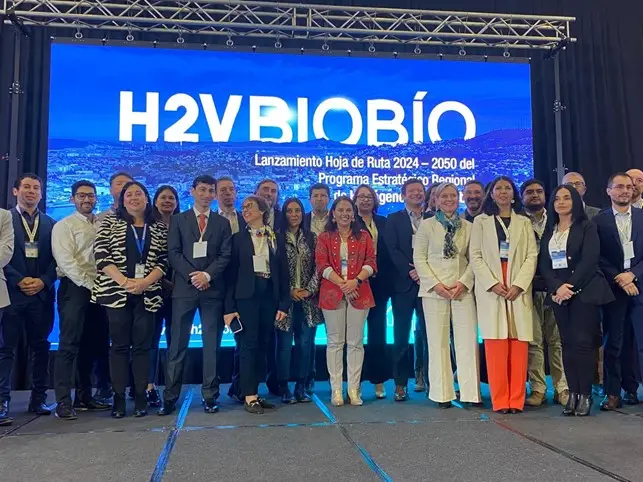
Ambassador Carmen Gonsalves together with TNO Science Institute expert Luisa Flechas made presentations at the event.
On 17 April, the launch of the GH2 Biobío Roadmap 2024-2050 was held in the city of Concepción, which seeks to decarbonise the area’s industry with the help of the Regional Government and Corfo’s Regional Productive Development Committee. The event was followed by field visits of the Dutch delegation, the German International Cooperation Agency (GIZ), Corfo and the Regional Strategic Programme (PER) Green Hydrogen for Biobío (known as H2V Biobío).
Collaboration between the Netherlands and Chile on green hydrogen goes back several years already, when in 2021 the Chilean Ministry of Energy and its counterpart in the Netherlands, the Ministry of Economic Affairs and Climate Policy, signed a Joint Declaration to support the strengthening of bilateral cooperation in the field.
In the framework of the strategic work agenda with Chile, the Embassy of the Netherlands was honoured to participate in the launch event. Ambassador Carmen Gonsalves made an intervention in Block 1, which referred to the construction of the Green Hydrogen Roadmap, shedding light on the relevance of international collaboration. Luisa Flechas, expert from the Dutch scientific institute TNO, participated in Block 2, which addressed the current perspective and Chile’s development potential, highlighting opportunities and lessons in the development of hydrogen valleys in the Netherlands.
After the event, field visits allowed Dutch expert Luisa Flechas to have an overview of the challenges and opportunities in terms of industrial transformation for the decarbonisation of Biobío. The visits included ENAP, the Universidad Católica de la Santísima Concepción, Ports of Talcahuano, Vidrios Lirquén and Arauco’s Nueva Aldea plant.
Regarding the potential in the Biobío Region, Luisa Flechas sees “a great opportunity with respect to industrial development, starting with the transition to low-carbon energies and then moving on to green hydrogen, either for the production of ammonium or methanol”.
Photo Credit: Paula Galilea, Embassy of the Netherlands in Chile